
Historical Annex Release Paths
The Haywood County Sheriff's Office documented the annex in its 2018 annual report as a 40-bed component next to the 109-bed main jail. The two buildings were then described as one detention operation with 149 rated beds. Current sheriff materials describe a 109-bed facility and do not present the annex as a separate public-facing jail. The accurate label is therefore historical component. No current operational status should be inferred without direct HCSO confirmation.
A person whose old record names the annex could have left after bond, time served, dismissal, or another court order. The departure could also have been a transport to the main component, another local confinement facility, a North Carolina prison, a medical or treatment setting, or a different custodian. The historical annex label identifies where part of the custody episode was recorded. It does not tell why the person left or where the person went.
Confirm Annex Release Records
Start with the name exactly as it appears on the old paperwork. Include both “Haywood County Detention Center” and “annex” in a records request so the custodian can locate material filed under either description. Add the person's full name, aliases, date of birth if lawfully known, approximate booking and release dates, and any case or booking number. Ask for the existing booking-and-release record rather than asking staff to reconstruct events from memory.
- Review the old document and preserve its facility wording, dates, and identifiers.
- Call HCSO current inmate information only if present custody also matters; a current result does not replace the old file.
- Submit a focused HCSO request for the named booking episode and identify the annex wording.
- Check the Haywood court case for bond, release order, judgment, dismissal, or commitment.
- Follow any transfer destination into the receiving jail, NCDAC, BOP, USMS, or ICE system.
A historical records search may take more matching work than a present-custody check. The Haywood County release search sets out the same custodian-first method for other custody types.
Annex Records and Contact
The HCSO Public Records Request form is the direct route for sheriff-created detention records. It offers delivery by email, pickup, or mail, allows HCSO to ask for clarification, and promises a response as expeditiously as possible. The form does not post a fixed turnaround or standard price for an annex release file. Request an estimate before authorizing an unusual charge.
Ask separately for booking date and time, release date and time, release disposition, destination or transfer agency, bond type and amount, charges at booking, arresting agency, booking number, and the booking photograph if it remains disclosable. Some fields may be redacted or withheld under law governing investigative, personal, juvenile, sealed, expunged, medical, or safety information. When a code appears, ask for an existing public code legend. Do not guess.
1620 Brown Avenue
Waynesville, NC 28786
Current inmate information: (828) 452-6670, option 1
Detention Captain Kevin Burress: (828) 356-2864
Office hours: Monday through Friday, 8 a.m. to 4 p.m.
The contact is for the current HCSO detention operation and historical sheriff records. It is not proof that the annex has a separate staff desk or public office today.
Three Annex Capacity Eras
Haywood detention capacity appears in three distinct source eras. The 2018 sheriff report described 149 rated beds across the 109-bed main jail and 40-bed annex. Current sheriff material describes 109 operational beds. In March 2024, North Carolina approved $28.5 million in county financing for expansion, and state planning material forecast 155 additional beds with estimated fiscal 2026 completion.
These figures cannot be blended. The 2018 total is historical, the current sheriff figure describes the public operating facility, and the expansion figure is a plan. Financing approval does not prove that construction is finished. Estimated completion does not prove that intake has begun. Added space should not be called operational until the responsible agency announces it.
The North Carolina Treasurer's financing announcement shows the public expansion context.
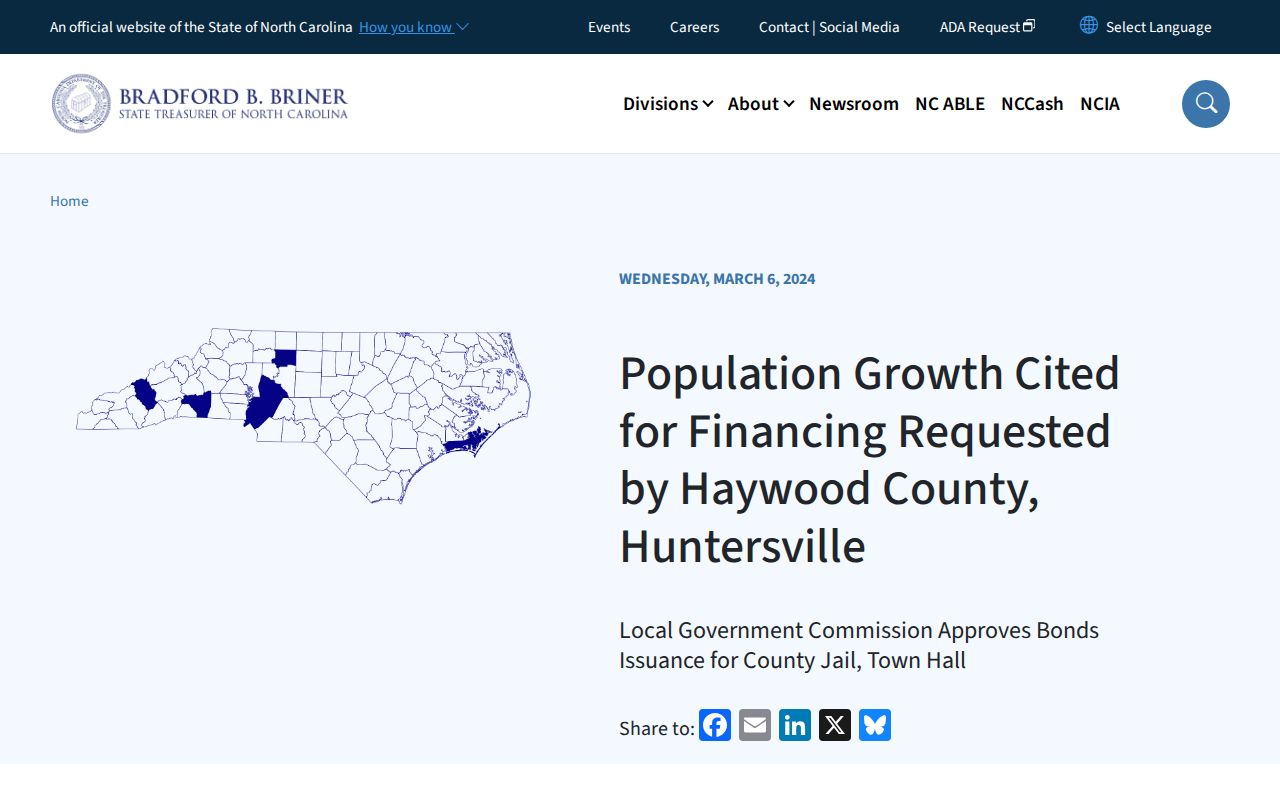
The captured state page supports the financing event, not a claim that the historical annex is currently open or that new beds are accepting people.
Reading Old Annex Records
The 2018 annual report recorded 4,016 bookings, an average daily population of 120, and an average stay of 11 days. Those values describe an operating year in which the report discussed both main and annex components. They do not prove that 4,016 unique people were held, and they are not a release count. One person can have more than one booking, while daily population and length of stay measure different facts.
Old documents may also use terms differently from current portals. “Release” can describe the end of HCSO custody even when another agency took control. “Transfer” is more precise when a receiving custodian is recorded. “Time served” concerns a sentence calculation, while “bond” describes pretrial release conditions. A missing current phone result decades or years later adds no useful proof about the historic event. The durable sheriff record and filed court material carry more weight.
Note: Preserve the source date beside every capacity and booking figure so a past annex description does not become a current claim.
Annex Release Court Records
The jail record answers when the person entered and left HCSO control. The court record answers what a judge, magistrate, or clerk entered in the criminal case. Haywood County uses the North Carolina eCourts system, but Portal is public docket access rather than the certified court file. Search the name with other identifiers, filter to Haywood County, open the criminal matter, and inspect its case summary and register of actions.
For an official copy, contact the Haywood Clerk of Superior Court at 285 N Main Street, Suite 1500, Waynesville, NC 28786, (828) 454-6501. Office hours are Monday through Friday, 8 a.m. to 5 p.m. Ask for a specific judgment, commitment, release order, dismissal, or docket sheet. A court disposition can explain the authority, but only the detention record should be used for the precise physical departure time.
After Historical Annex Custody
The 2018 sheriff report documented 200 trips to local confinement facilities and 83 prison trips. These counts show why an old Haywood confinement episode may continue elsewhere. A person moved to another county remained in local custody. A person delivered to NCDAC remained confined in the state system. NC SAVAN/VINELink may help identify a custody event, while the receiving agency's record establishes its own admission and later release.
No NCDAC prison, BOP institution, or ICE detention center was identified as physically located in Haywood County. Even so, an outside agency could become the next custodian. That fact does not turn the annex into a state, federal, or immigration site. Each system keeps its own status labels and time horizon. Keep the old annex record tied to HCSO, then follow a sourced destination without merging two agencies into one release.
Haywood Annex Historical Access
North Carolina public-record law applies to existing government records, but it does not require HCSO to create a new historical report. A request should identify a booking episode and ask for named records or fields. Chapter 132 starts broadly, while G.S. 132-1.4 treats criminal investigation material differently and preserves access to specified basic arrest information. Juvenile, sealed, expunged, medical, personal, and safety material can also affect a response.
Age alone does not make an annex record public or confidential. Retention and access depend on the record series and governing law, and no Haywood-specific online retention period for released profiles was found. If HCSO cannot locate a file under “annex,” ask whether the same episode is indexed under Haywood County Detention Center, Law Enforcement Center, booking number, or case number. That is a search clarification, not a claim that the annex operates now.
When only part of a record is withheld, ask for the separable public portion and a written explanation of the legal basis for denial. For the court side, request the judgment, release order, dismissal, or docket sheet from the clerk. An expunction can later limit public court access, so a missing current case does not disprove an older custody event. Preserve any lawful old record with its source date and do not use a historical copy to state present custody.
Confirm Haywood Annex Status
Before describing any present annex use, call HCSO and ask what facility name applies to the current operation. A construction update, financing record, or old annual report cannot establish intake status. Record the agency response date and keep it separate from the historical release inquiry.
Public Record Search
Sponsored Results