
Haywood County Booking Photo Law
North Carolina's public-record definition in G.S. 132-1 includes photographs and electronic records made or received in public business. That broad rule is only the starting point. G.S. 132-1.4 excludes criminal-investigation and criminal-intelligence records from the general definition, while making specified basic arrest information public unless another law bars disclosure.
A booking photo may be made by an agency, but public access can depend on why and how it is maintained, the law-enforcement exception, a juvenile rule, a safety issue, or a sealing or expunction order. G.S. 15A-502 authorizes photographs and fingerprints in specified arrest, detention, imprisonment, and conviction settings. It does not say every photograph must be posted on a public website.
The best statement is narrow: ask HCSO for the existing photograph tied to an identified booking and let the custodian apply current law. If access is denied, ask for the legal basis in writing and request any nonexempt booking-and-release fields. Do not claim that all Haywood County mugshots are automatically public or categorically closed.
The state statute page below shows why the investigation-record rule must be checked before making a broad photo-access claim. It comes from the official G.S. 132-1.4 source.
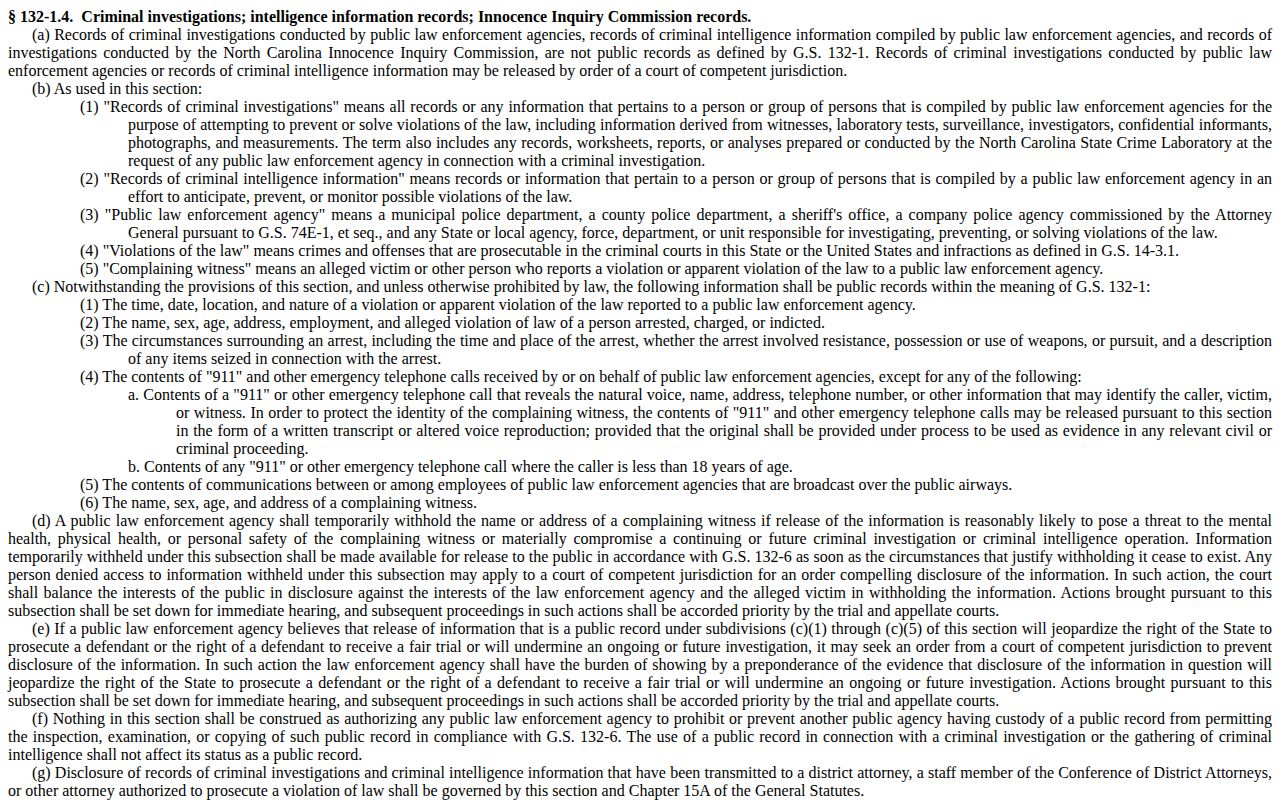
The statute separates criminal-investigation material from basic information that another subsection makes public, so the record's nature and custodian response remain decisive.
Haywood County Mugshot Sources
The source must match the custody episode. HCSO is the county route for a Brown Avenue booking. NCDAC may show a state correctional image when the person entered state custody. The SBI registry serves only people with a statutory duty to register. Press and news photographs document publication, not the later release event.
| Channel | Has a photo? | How to access |
|---|---|---|
| HCSO web detention page | No current profile or photo gallery located | Use the phone for current custody, then request the booking photo |
| HCSO public-record request | Possibly, if an existing photo is disclosable | Identify the booking and ask for the photo plus release record |
| NCDAC offender profile | Can contain a state correctional image | Match the offender number and open the state profile |
| NC sex-offender registry | Contains images for covered registrants | Use only for the narrow statutory population |
| Sheriff press release or local news | Sometimes | Label the publisher and date, then verify release elsewhere |
| Commercial archive | May carry copied images | Treat only as a lead; do not rely on it for custody or disposition |
VINELink is mainly a custody-status and notification channel. It should not be promised as a booking-photo archive. The North Carolina court Portal can explain disposition but may not display the county booking image. Each system answers a separate question.
No Haywood County Photo Roster
The Haywood County Sheriff's detention page does not publish a browser roster, current inmate profiles, released profiles, or booking photographs. Its advertised inmate-information route is (828) 452-6670, option 1. The sheriff says the telephone data refreshes every 15 minutes and covers charges, bond amounts, and residential information. The page does not state that photographs or a release archive are available by phone.
This absence makes a focused records request the county-specific path. A photo found elsewhere should not be labeled “the Haywood release mugshot” without reconciling it to the correct booking. A state prison image may be later than the county photo. A registry picture can reflect a separate update. A press photo may predate the final case outcome.
Pair the requested photo with the booking-and-release record. Seek the booking number, booking date, release date and time, release disposition or destination, and the related photograph. The photo proves an image was created or kept. The release fields show whether and how the county custody event ended.
Note: Haywood County publishes no stated retention window for a released profile because no official online profile archive was located.
Request Haywood County Mugshots
Use the HCSO Public Records Request form for records prepared, collected, or maintained by the sheriff. The form accepts a description and delivery choice of email, pickup, or mail. It says the office may seek clarification and will respond as expeditiously as possible. No fixed booking-photo fee or response deadline appears on the reviewed page.
Ask for an existing record, not an explanation or a new report. Give the full legal name, aliases when relevant, date of birth if lawfully known, approximate booking date, and booking or case number. Precise identifiers reduce the chance of attaching the wrong photograph to a common name.
- Identify the exact Haywood County booking episode with name, date, and booking number if known.
- Request “the booking photograph associated with that identified booking, if public.”
- Request the booking-and-release record in the same submission, including release date, time, disposition, and destination if public.
- Choose electronic delivery and ask for a cost estimate before authorizing a charge.
- If material is withheld, request the legal basis in writing and ask for all nonexempt portions.
- Compare the response with the court case before describing release or disposition.
Chapter 132 generally limits ordinary copy charges to direct actual reproduction cost, while a reasonable special service charge may apply for extensive technology or clerical work. The agency need not create or compile a record that does not exist. HCSO, not a private archive, should explain any charge applied to the request.
Haywood County State Photo Checks
The NCDAC Offender Public Information Search can display a photograph in a state offender's identity panel. It applies to North Carolina state-prison history and community supervision, not a purely local Haywood County jail stay. Match the offender number, birth date, and sentence details before treating the profile as the same person.
A state photo is not the Haywood booking image. It also does not prove that the person was released by HCSO. Read incarceration status, Actual Release Date, release type, and supervision status. If the county phone channel stopped returning the person while DAC shows active incarceration, the likely custody path is a transfer to the state, not community release.
The North Carolina Sex Offender and Public Protection Registry can carry an image, address, physical description, conviction, sentence, and registration status for someone legally required to register. It excludes most people released from custody. Its absence says nothing reliable about an ordinary jail release, and its image should be labeled as a registry photo rather than a jail mugshot.
Avoid the Tennessee Mugshot App
No official Haywood County, North Carolina sheriff app advertising recent releases or mugshots was located through the reviewed official channels. Search engines can surface an app named “Haywood County Sheriff” that belongs to Haywood County, Tennessee. That is another agency, jurisdiction, and dataset. It must not be used for a North Carolina booking or release claim.
The North Carolina sheriff site links official Facebook and X accounts, but the detention page does not say those accounts publish a systematic release list or photo roster. A social arrest post can show what the agency published at one moment. It should not be converted into proof of release, sentence completion, or present custody.
Jurisdiction checks are simple but vital. Confirm the state, agency domain, facility address, and booking source before saving an image. Then seek the release event from HCSO, VINE, or the proper receiving agency. A familiar county name alone is not enough.
Haywood County News Photo Limits
Sheriff annual reports, county records, state financing announcements, and regional news describe Haywood detention operations and expansion. None is a systematic released-person blotter. A local story or official press release may preserve an arrest image and an allegation, yet publication does not show that the person later left custody or how the case ended.
Use news only to discover a possible booking or to understand a dated event. Confirm physical release with HCSO or VINE. Confirm legal disposition in the North Carolina court record. If the person entered state custody, use NCDAC. Captions should name the image source and publication date and state that custody and disposition were checked independently.
Commercial mugshot and jail pages are still weaker. Their photos can be copied, stale, mislabeled, or linked to an arrest with no later outcome. No commercial publisher should be treated as the Haywood County record custodian, and paid removal services should not be endorsed.
Read Haywood County Mugshots Carefully
A booking photograph proves neither guilt nor current custody. It may outlast a dismissal, acquittal, expunction, sentence completion, transfer, or release. Placing an old arrest image beside a “released” label without a sourced event can create a false impression. Omit the photograph when identity, source, or legal status cannot be reconciled.
Use a three-record test. First, identify the source and booking date of the image. Second, identify the custody record and actual release or transfer event. Third, inspect the court disposition. If those records disagree, preserve the distinct labels and ask the relevant custodian to resolve the conflict.
- Booking photo
- An agency image tied to an arrest or confinement episode.
- Release record
- The custodian's record of the date, type, authority, or destination when custody ended or moved.
- Disposition
- The court's recorded outcome or order in the criminal case.
- Expunction
- A court process that removes and seals or destroys covered state records under the governing law.
Haywood County Mugshot Expunction
The North Carolina Judicial Branch says a granted expunction removes a covered charge or conviction and seals or destroys the state's arrest, charge, and/or conviction records. Eligibility and timing depend on the statute. A petition is filed with the clerk in the county of charge or conviction, and some waiting periods include the final end of probation, parole, or post-release supervision.
An old private copy may remain after the government record is removed. Continued private publication does not prove that the official case remains public. Likewise, a missing image does not prove the arrest never occurred or that release happened on a certain date. For an official-source correction, identify the image, booking, asserted error, and supporting government document, then ask the custodian about its correction or annotation process.
North Carolina lawmakers have proposed broader booking-photo restrictions, but the research did not locate a currently enacted general pay-to-remove law or categorical ban on all booking-photo disclosure. Bills are not law merely because draft text exists. Apply current Chapter 132 rules, the investigation-record exception, and any case-specific order.
Prohibited use: Haywood County Released Inmates is not a consumer reporting agency, and mugshot information may not be used for credit, employment, tenant, insurance, or any other FCRA-covered purpose.